

Views: 0 Author: Site Editor Publish Time: 2026-07-27 Origin: Site


Standard household storage bins fail rapidly in outdoor environments. Cold temperatures shatter brittle plastics. Transit vibrations compromise weak friction-fit lids. Direct sunlight degrades materials until they crack. Disorganized, damaged, or moisture-compromised gear ruins outdoor experiences and wastes valuable time at the campsite. When you arrive after a long drive, you need immediate access to dry tents, intact cooking equipment, and secure food supplies. A reliable storage system acts as essential infrastructure for frequent campers, overlanders, and outdoor professionals. You need purpose-built, weather-resistant solutions to protect your equipment from dust, rain, and physical impact. This technical guide evaluates the top-rated camping storage containers based on material durability, lid security, modularity, ergonomics, and specific use-case viability. We will help you build a robust, scalable system that keeps your gear dry, accessible, and secure regardless of the environment.
Material Dictates Lifespan: High-Density Polyethylene (HDPE) and roto-molded plastics severely outperform standard polypropylene in UV resistance and impact strength.
Lid Integrity is Paramount: A container is only as effective as its lid mechanism; gasket-sealed, latching lids are mandatory for weather and dust resistance.
System Modularity & Portability: Soft-sided hybrids or folding options offer superior space efficiency for transit, but often sacrifice absolute crush-proof protection.
Visibility vs. Security: Transparent containers allow for rapid inventory checks, while opaque containers offer better security and UV protection for sensitive gear.
Use-Case Specificity: No single container excels at everything; optimal setups utilize a mix of heavy-duty gear cases, hybrid duffels, and specialized food storage boxes.
To build an effective gear management system, you must evaluate containers against strict operational standards rather than aesthetics. Outdoor gear faces dynamic loads, extreme temperature swings, and constant exposure to elements. A box that sits perfectly still in a garage will experience severe stress when strapped to a roof rack driving down a corrugated dirt road.
The base polymer used in a container dictates its operational limits. Manufacturers typically rely on four primary materials, each offering distinct advantages and failure points in the field.
Material Type | Impact Resistance | UV Tolerance | Temperature Range | Best Application |
|---|---|---|---|---|
High-Density Polyethylene (HDPE) | Excellent | High | -40°F to 140°F | Heavy-duty expedition boxes, truck bed storage |
Polypropylene (PP) | Moderate | Low to Moderate | 32°F to 180°F | Budget utility bins, interior vehicle storage |
Polycarbonate (PC) | High | Moderate | -20°F to 200°F | Clear storage bins, high-visibility organization |
Thermoplastic Polyurethane (TPU) | Flexible/Tear-Resistant | High | -30°F to 150°F | Soft-sided hybrid containers, collapsible bags |
Outdoor storage faces extreme environmental stress from the moment it leaves your vehicle. UV stabilization prevents summer warping and stops the plastic from chalking and breaking down over time. High temperature tolerance stops winter cracking when handling frozen bins. You must also verify water and dust ingress protection. Look for specific IP (Ingress Protection) ratings if you transport gear in open truck beds or roof racks.
IP54: Protects against solid objects and splashing water. Suitable for interior vehicle storage.
IP65: Blocks heavy rain and fine dust. Ideal for roof racks and open truck beds.
IP67: Allows for temporary submersion during river crossings. Mandatory for extreme overlanding and marine environments.
A reliable container must support heavy vertical loads without buckling. Stackability ensures safe transit in packed vehicles, preventing the bottom bins from collapsing under the weight of the top bins. Reinforced corners and honeycomb-patterned lids prevent structural failure during impacts. The best containers can double as camp seating, a step stool, or a makeshift table without any structural deflection. When you strap a box down with heavy-duty ratchets, the walls must resist the compressive force without warping the lid seal.
Friction-fit lids have an exceptionally high failure rate during transit. When a vehicle hits a bump, the chassis flexes, and friction lids pop off, spilling gear across your trunk. Mechanical cam-latches and metal hinges provide secure, positive closures. Integrated EPDM rubber gaskets seal out moisture and fine silt on dirt roads. A strong lid mechanism dictates the overall reliability of the entire container. If the latches fail, the gasket cannot compress, and the environmental seal is broken.
A fully loaded bin requires ergonomic grab points. Poor handle design causes hand fatigue and increases the risk of injury when moving heavy gear from a vehicle to the campsite. Look for comfortable, recessed handles that do not protrude beyond the box's footprint. Integrated tie-down loops are mandatory. These features ensure safe lifting and allow you to secure the box to a vehicle without strapping over the lid, which restricts access to your gear.
Clear lids or transparent polycarbonate side panels allow rapid visual inventory. You can locate specific items like headlamps or stoves without opening the box. Traditional opaque construction hides valuable gear from prying eyes at trailheads and blocks harmful UV rays from degrading sensitive fabrics like tent flies. Choose your visibility level based on your security needs and organizational style. Many experienced campers use opaque boxes for exterior storage and clear boxes for interior vehicle organization.
These rugged boxes serve as the ultimate defense against harsh elements, rough handling, and extreme environments. They are over-engineered to survive conditions that would destroy standard plastic bins in minutes.
Overlanders, truck campers, and off-grid explorers rely heavily on this category. Users transporting high-value or fragile gear like electronics, camera optics, and emergency communication devices require maximum physical protection. If your gear sits exposed on a roof rack through rainstorms and dust trails, you need expedition-grade storage.
Roto-molded construction provides unmatched impact resistance. The manufacturing process heats plastic inside a mold that rotates on two axes, creating a continuous, single-piece shell with uniform wall thickness and zero stress points at the corners. Integrated tie-down points secure boxes to roof racks safely. Padlock compatibility deters theft at unattended campsites. Absolute waterproofing ensures sensitive equipment stays dry. Many high-end models also feature pressure release valves. These valves equalize internal pressure after significant elevation changes, preventing the lid from vacuum-sealing shut when you drive from sea level to high mountain passes.
Industry standards include the Yeti LoadOut GoBox and Dometic GO series. These units represent the top tier of outdoor storage engineering.
Pros: Near-indestructible build, superior dust and water seals, massive load-bearing capacity, and excellent internal organization trays.
Cons: High empty weight, rigid footprint that consumes maximum space even when empty, and a significant upfront investment.
Assess the value-to-lifespan ratio carefully. Premium features provide peace of mind for prolonged off-grid expeditions where gear failure is not an option. However, weekend car campers rarely need roto-molded protection for sleeping bags and clothes. Match the durability level to your actual environmental exposure to avoid carrying unnecessary weight. A 20-pound empty box quickly becomes a 70-pound liability once loaded with heavy tools and recovery gear.
Modern camping demands flexible storage solutions that adapt to limited vehicle space and varied trip lengths. Rigid boxes are excellent for protection, but they consume the same volume whether full or empty.
Campers with limited vehicle space, such as those driving sedans or small crossovers, benefit greatly from these systems. Apartment dwellers with minimal home storage and adventure travelers need a highly portable camping storage container that packs away easily when the trip ends. These users prioritize adaptability over absolute crush resistance.
Collapsibility saves valuable space between trips. Hybrid material construction combines rigid frames with flexible TPU-coated or heavy-duty nylon walls. The TPU coating adds high abrasion resistance and water repellency to standard nylon, allowing the container to drag across dirt or rocks without tearing. This allows the container to hold its shape while packing but compress when empty. Modular integration allows smaller packing cubes to nest within larger systems efficiently, creating a cohesive gear ecosystem.
Popular options include the Rux 70L Gear System, Patagonia Black Hole Gear Tote, and Gregory Alpaca Gear Box.
Pros: Collapses flat when empty, lightweight design, versatile carrying options including backpack straps and duffel handles, and available in clear panels for rapid gear identification.
Cons: Lower crush resistance compared to hard cases, potential wear points at folding seams, and vulnerability to sharp impacts or punctures.
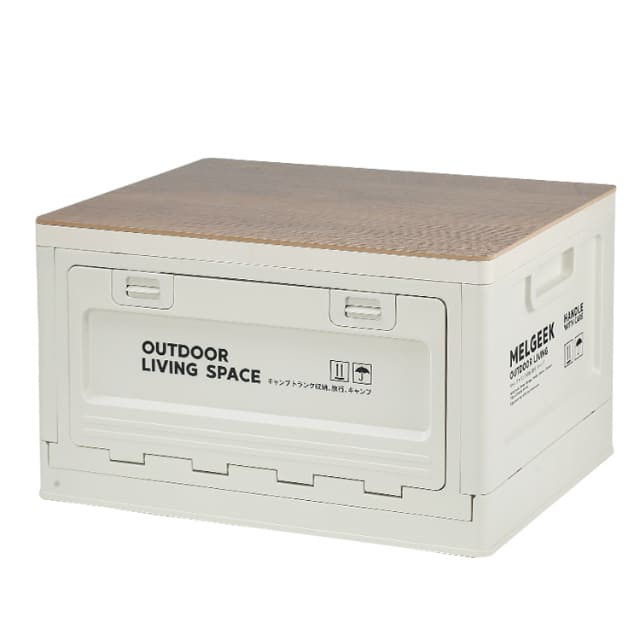
A rigid folding camping storage box serves as excellent secondary storage. They organize clothing, sleeping pads, or lightweight dry goods perfectly. You must keep them out of direct rain and avoid heavy structural loads, as the hinges can buckle under extreme weight. When empty, they fold completely flat to maximize vehicle space on the return trip, making them highly efficient for firewood transport or temporary camp trash management. Look for models with interlocking tabs that keep the walls rigid during transport.
Practicality, high volume, and accessibility define this widely used storage category. These bins form the backbone of most recreational camping setups.
Families needing bulk storage solutions for sleeping bags and large tents rely on utility bins. DIY organization enthusiasts appreciate the customization potential of these standard containers. If you need to store large volumes of non-fragile gear in the back of an SUV, this category offers the best volume-to-weight ratio.
Impact-resistant plastics handle basic camp abuse and sliding around in truck beds. Secure snap-latches keep lids attached during bumpy rides. Standardized sizing allows tight vehicle packing. This uniform shape maximizes cubic inches in a cargo area, often referred to as the "Tetris-factor." When all your bins share the same footprint, you eliminate dead space in your vehicle.
The Rubbermaid ActionPacker 24-Gallon and ULINE Industrial Totes dominate this space.
Pros: Highly accessible, proven long-term durability, widely available, and optimal volume-to-weight ratio.
Cons: Lack of rubber gaskets means they resist water but are not waterproof. They feature basic latching mechanisms and less aesthetic appeal.
You can maximize the utility of these bins through simple aftermarket modifications. Adding DIY weather stripping using automotive D-profile EPDM rubber seals improves dust and water resistance significantly. Clean the plastic lip with isopropyl alcohol, peel the adhesive backing, and press the seal into the groove. The 24-gallon size is widely considered the sweet spot for handling. It holds ample gear while remaining light enough for one person to lift safely without straining their back.
Protecting your food supply is mandatory for human safety, wildlife protection, and overall trip success. A compromised food supply forces an early end to any camping trip.
All campers require safe, pest-resistant pantry organization. Proper food storage prevents wildlife encounters, keeps supplies intact, and maintains camp hygiene. Whether you camp in a state park or deep in the backcountry, animals will actively seek out your food.
A dedicated camping food storage box must use food-grade, BPA-free materials to prevent chemical leaching into dry goods. Odor-blocking seals prevent wildlife from detecting your pantry from a distance. Smooth internal surfaces ensure easy sanitization after spills. If you camp in bear country, Interagency Grizzly Bear Committee (IGBC) certification is mandatory to comply with local regulations. The IGBC tests containers using captive grizzly bears. A container only passes if the bear cannot breach it within 60 minutes of continuous biting, clawing, and crushing.
Standard dry-boxes differ entirely from certified bear-resistant containers. Gasket seals keep out micro-pests like ants, spiders, and mice effectively. However, stopping macro-pests like raccoons and bears requires heavy-duty locking mechanisms and reinforced walls that withstand crushing jaws. Assess your local wildlife threats before selecting a food storage solution. A simple latching bin works for the beach, but a certified lockbox is required in the mountains. Rangers will issue citations if your food is not stored in an IGBC-certified container or a hard-sided vehicle in designated bear habitats.
Selecting the right gear involves balancing competing priorities. No single box solves every storage problem perfectly. You must evaluate your specific needs against the physical limitations of the containers.
The heavier the empty container, the more durable it typically is. Roto-molded boxes survive extreme abuse, falls from roof racks, and bear attacks. However, they introduce a significant payload penalty to your vehicle. Consider the physical strain of moving fully loaded heavy boxes around camp. Lighter bins save physical energy and vehicle payload capacity but require more careful handling. A heavy box placed high on a roof rack also raises your vehicle's center of gravity, negatively impacting off-road handling.
Buying multiple identical bins makes stacking and packing much easier. Uniform shapes lock together securely in transit, preventing load shift. Conversely, investing in specialized, differently sized containers protects specific gear types better. A long, narrow box fits tent poles perfectly, while a deep, square box holds a camp stove. A mixed approach often yields the best results: uniform bins for bulk gear and specialized cases for delicate items.
Top-loading bins require unstacking to access bottom units. This slows down camp setup and frustrates users looking for a single item. Evaluate if the lid design allows for quick access. Some systems let you open lids on a hinge without completely removing the container from a vehicle rig or trunk. Front-loading drawers offer superior accessibility but consume more space and add mechanical complexity.
Container Category | Best Use Case | Durability Level | Water Resistance | Weight Profile |
|---|---|---|---|---|
Heavy-Duty & Expedition | Overlanding, fragile gear | Extreme (Crush-proof) | 100% Waterproof (Submersible) | Heavy |
Space-Efficient & Hybrid | Limited space, adventure travel | Moderate (Flexible) | Water-Resistant | Lightweight |
High-Value Utility Bins | Families, bulk storage | High (Impact-resistant) | Splash-Resistant | Medium |
Dedicated Food Storage | Pantry organization, bear country | Variable (IGBC options available) | Odor-blocking, Water-Resistant | Variable |
Even the best storage systems fail if packed or maintained incorrectly. User error accounts for the majority of damaged gear in the field.
Highly sealed containers trap internal moisture easily. When temperatures drop at night, trapped ambient humidity reaches its dew point and condensates on the inside of the lid. This leads to destructive mold on tents, sleeping bags, and clothing.
Use large silica gel packets inside sealed boxes to absorb ambient moisture.
Ensure all gear is 100% dry before closing the lid.
Never pack a damp rainfly into a sealed gasket box without venting it as soon as you get home.
Purchasing based solely on liter volume causes packing disasters. A 100L box might hold all your gear but fail to clear your trunk opening or sit flat between wheel wells.
Measure your exact trunk or truck bed clearance first.
Account for wheel well intrusion, tailgate angles, and sloped rear windows before purchasing rigid boxes.
Create a cardboard mockup if you plan to buy multiple large bins to test the fitment physically.
Large volume bins exceeding 75 liters become dangerously heavy when filled with dense items like cast iron pans, tools, or canned food. This leads to lifting injuries and damaged gear at the bottom of the bin.
Restrict large bins to bulky, lightweight items like sleeping bags and clothing.
Use smaller 40L to 50L bins for dense, heavy gear to maintain a manageable lifting weight.
Always place the heaviest bins at the bottom of your vehicle stack to maintain a low center of gravity.
A large bin easily becomes a dark void where small items disappear. Digging through a massive box for a headlamp defeats the purpose of an organized system.
Implement a strict micro-organization strategy using color-coded packing cubes.
Use clear zippered pouches inside the main bin for small items like batteries and utensils.
Always place heavy items at the bottom to prevent crushing delicate items during transit.
The best container is dictated by your specific environmental demands, vehicle cargo space, and the types of gear you carry. Stop relying on fragile household bins that crack in the cold and pop open on dirt roads. Upgrade your camp infrastructure today to protect your equipment, speed up your camp setup, and streamline your outdoor experience.
Audit your current gear inventory and group items by weight, dimensions, and moisture sensitivity.
Measure your vehicle's cargo area, accounting for wheel wells and tailgate angles, to determine maximum container dimensions.
Select one heavy-duty, gasket-sealed container for electronics and dry clothing, supplementing with lighter utility bins for camp kitchen supplies.
Apply automotive weather stripping to any non-gasketed utility bins to improve dust and water resistance immediately.
A: It depends on the seal. Containers with integrated rubber gaskets and mechanical latches keep gear dry during heavy rain. Standard utility bins without gaskets leak if exposed to direct downpours. Always check the IP rating before leaving boxes exposed to the elements.
A: Never pack damp gear. Even slight moisture from morning dew will evaporate and condense inside a sealed box. Toss several large, reusable silica gel desiccant packs into the container to absorb trapped ambient humidity effectively.
A: Clear polycarbonate bins are highly impact-resistant and excellent for visibility. However, clear plastics offer less UV protection. If you store gear in direct sunlight for extended periods, opaque bins prevent UV degradation of your equipment.
A: The 24-gallon to 50-liter range is the optimal sweet spot. Bins larger than 75 liters become too heavy for one person to lift safely when packed with dense items. Smaller bins promote better weight distribution and easier vehicle packing.
A: No. Bear-resistant containers are only necessary, and often legally required, in designated bear habitats. For standard campgrounds without large predators, a secure, odor-blocking food box keeps out common pests like mice and raccoons effectively.
A: Use containers with integrated tie-down slots. Run ratchet straps through these slots rather than over the lid. This secures the box firmly to the truck bed while still allowing you to open the lid without undoing the straps.


