

Views: 0 Author: Site Editor Publish Time: 2026-05-06 Origin: Site


In small floor plans, your main living area often acts as a lounge, dining area, and home office simultaneously. Without an intentional strategy, visual clutter accumulates rapidly. This chaos immediately shrinks the perceived size of your room. Effective small-space organization requires moving beyond purely aesthetic inspiration. You must evaluate solutions based on cubic capacity, footprint efficiency, and aesthetic integration. We created this definitive, decision-stage guide to help you evaluate, shortlist, and implement smart solutions. You will learn how to choose everything from macro furniture investments to micro-surface organizers. Every square inch counts when multiple activities share the same room. Our actionable advice ensures your upgrades deliver maximum impact. We will show you how to maximize capacity without sacrificing valuable floor space or violating your lease agreement. Let us dive into the precise strategies you need to reclaim your environment.
Prioritize a 70/30 ratio of concealed-to-open storage to minimize visual fatigue.
Dual-purpose furniture (e.g., storage ottomans, lift-top tables) yields the highest spatial ROI in sub-200 sq. ft. living rooms.
Hybrid living/workspace zones require specialized micro-storage to prevent office creep.
Scalable, modular systems offer safer long-term investments for renters compared to custom built-ins.
You cannot organize a space effectively without first understanding your inventory. Conducting a comprehensive volume audit provides a reliable baseline. This audit prevents you from buying redundant organizational pieces. Start by dragging every loose item into the center of the room. You must then categorize these items strictly by their usage frequency and visual appeal. We recommend dividing everything into three distinct categories.
Category | Definition & Examples | Ideal Location |
|---|---|---|
Frequent Access | Items used daily. Remotes, phone chargers, coasters. | Surface-level organizers, top drawers. |
Display | Aesthetically pleasing items. Art books, vases, plants. | Open floating shelves, glass-front cabinets. |
Concealment | Functional but ugly items. Routers, cables, seasonal blankets. | Deep bins, solid-door consoles, lift-top tables. |
After categorizing your belongings, apply the 70/30 rule. You should evaluate potential purchases against the rule of keeping 70% of items behind closed doors or drawers. Only leave 30% on open display. This ratio dramatically reduces visual fatigue. The human eye struggles to process dozens of small objects simultaneously. Hiding the majority of your items calms the environment instantly.
Next, you must establish strict measurement constraints. Clearance and traffic flow dictate your ultimate comfort. A room feels cramped when you have to squeeze past furniture. Ensure a minimum 18-inch clearance around coffee tables. This allows comfortable legroom while keeping the table within arm's reach. Furthermore, maintain a 30-inch clearance for high-traffic walkways. Measure these invisible zones carefully before selecting bulky furniture. Masking tape works wonderfully for outlining future furniture footprints directly on your floor.
Every piece of furniture in a compact room must earn its footprint. Single-use items waste valuable square footage. Integrating hidden compartments into your primary seating and tables offers incredible spatial returns. When shopping for effective Living Room Storage, look closely at the mechanical hardware.
Storage ottomans and benches provide excellent stealth capacity. They are ideal for rapidly hiding bulky items like throw blankets or board games. However, you must evaluate weight limits and hinge durability. Flimsy hinges warp under frequent use. Look for pneumatic safety hinges. These prevent the heavy lid from slamming down on fingers. A sturdy bench can double as extra seating during gatherings.
Lift-top coffee tables revolutionize hybrid spaces. They assess mechanism stability and internal depth brilliantly. These tables are best for transitioning living rooms into temporary dining or workspace areas. The elevating top brings your laptop to a comfortable typing height. Underneath, a deep cavity remains hidden. You can conceal laptops, notebooks, and remotes easily. Always test the lifting mechanism for lateral wobble before purchasing.
Media consoles require special attention regarding door hardware. Compare sliding doors versus standard hinges. Standard swinging doors demand an extra foot of clearance to open fully. Sliding doors require zero outward clearance. This mechanical advantage makes them strictly superior for narrow living rooms. You can access your electronics without blocking the main walking path.
You must also beware of implementation risks. "Over-scaling" ruins many well-intentioned upgrades. Furniture exceeding 20 inches in depth will dominate a small room. This happens regardless of its internal capacity. Always prioritize shallow, wide units over deep, bulky ones to preserve your navigable floor area.
When floor space runs out, you must build upward. Utilizing your vertical real estate draws the eye higher. This creates an illusion of higher ceilings and a larger room overall. Choosing the right system depends entirely on your housing situation and structural constraints.
Renters face specific challenges regarding property damage. You must compare renter-friendly tension-mounted shelving against drilled, wall-mounted systems. Tension poles use floor-to-ceiling pressure to hold massive weight securely. They leave zero holes behind. Heavy-based freestanding bookcases offer another lease-compliant alternative. Conversely, homeowners can commit to permanent, floating wall systems for a cleaner aesthetic.
Evaluating modular systems requires forward-thinking. Look for ecosystems that allow you to add components over time. A good modular system lets you purchase the basic frame today. Next year, you can add drawers, solid doors, or display boxes. This phased approach mitigates your upfront cost. It also adapts to your changing inventory seamlessly.
Installation realities dictate the safety of your setup. Wall-mounted shelving must be secured directly to wooden studs. This becomes critical when holding heavy books or dense media equipment. Drywall anchors are insufficient for high-load applications. They will eventually pull out of the wall, causing catastrophic damage. Invest in a reliable magnetic stud finder.
Always place your heaviest items on the bottom shelves to lower the center of gravity and prevent tipping.
Leave intentional negative space (empty areas) on higher shelves to prevent the room from feeling top-heavy.
Use matching opaque bins on lower shelves to hide mismatched items while maintaining a cohesive look.
Macro furniture solves the large volume problems. Micro-storage solves the daily visual chaos. Small apartments frequently combine living and working zones. The WFH and living room overlap creates significant challenges. Surface clutter on coffee tables and side tables destroys the relaxing aesthetic of the room. A beautiful sofa means nothing if the table beside it looks like a chaotic office desk.
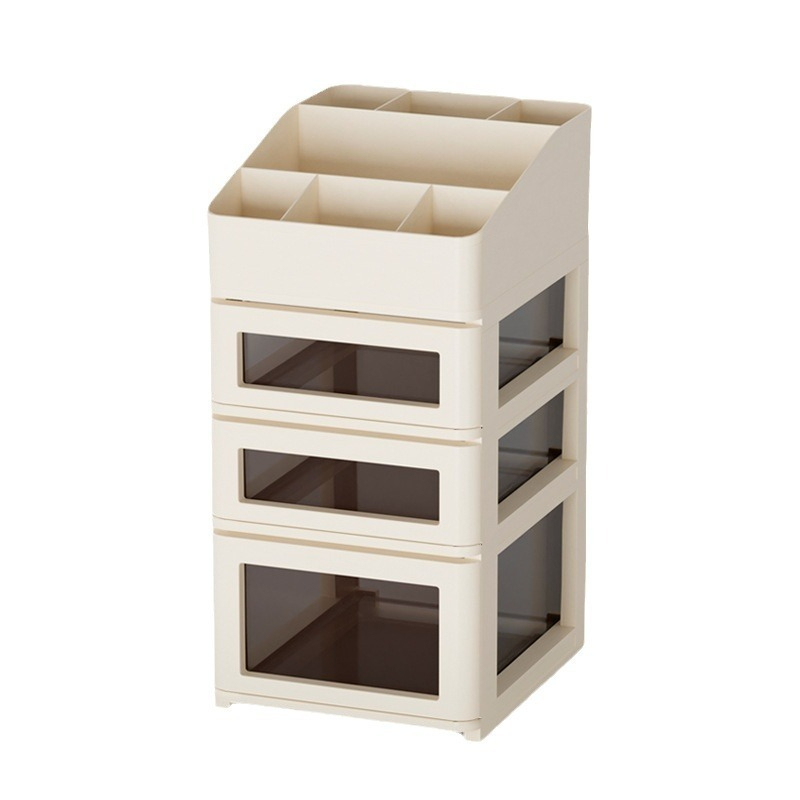
Concealing tech and stationery requires discipline. You should utilize closed, stylized organizers to hide loose cables, pens, and chargers. Open trays simply display the mess. Instead, incorporating a Cream Style Drawer Type Office Desktop Storage Cabinets allows for seamless integration of office supplies. It fits perfectly into a soft, modern living room aesthetic. The gentle curves and neutral tones ensure the piece never looks overly corporate. You can slide your sticky notes and charging blocks out of sight at 5:00 PM. This ritual helps mentally separate work time from relaxation time.
You should also replace single-use items with dual-purpose accessories. Every item on your coffee table must earn its keep. For family spaces or casual reading corners, a Multifunctional Cartoon Desktop Tissue Box for Office Home acts as functional decor. It can hold tissues while simultaneously organizing remotes, phones, or reading glasses in its integrated side compartments. It centralizes your daily necessities into one neat footprint.
Apply a strict evaluation lens to all micro-storage. You should judge these small items on daily accessibility and material quality. Avoid brittle, shiny plastics. They look cheap and break easily. Favor durable, matte finishes or natural textures. They elevate the tactile experience of the room.
Eventually, you will face the ultimate organizational debate. Should you invest in permanent architecture or flexible furniture? This decision impacts your finances and your space efficiency heavily. We must analyze both avenues objectively.
Custom built-ins represent a high investment strategy. They are best suited for homeowners. True custom carpentry maximizes awkward alcoves flawlessly. It utilizes floor-to-ceiling space perfectly, leaving no dead zones. The flush, seamless look elevates property value significantly. However, you face notable drawbacks. Built-ins demand a high upfront cost. They are permanently fixed to the property, meaning they cannot move with you. Furthermore, they require extended installation timelines involving contractors and dust.
Freestanding and semi-custom options offer high flexibility. Many creative organizers utilize pre-fabricated base cabinets placed side-by-side. They then mount standard floating shelves above them. This mimics the built-in look effectively. The benefits are substantial. You spend a fraction of the cost of custom carpentry. The entire system remains adaptable. You can achieve this setup as a weekend DIY project using standard tools.
Evaluation Criteria | Custom Built-Ins | Freestanding & Semi-Custom |
|---|---|---|
Spatial Efficiency | Maximum (Fits exact room dimensions) | Moderate (Relies on standard sizing) |
Adaptability | Zero (Fixed to property) | High (Can be relocated or reconfigured) |
Implementation Time | Weeks (Contractor required) | Hours to Days (DIY friendly) |
The final verdict relies on your timeline. If you are renting or planning to move within three years, allocate your budget to high-quality freestanding modular pieces. You take your investment with you. If you are staying five or more years, custom built-ins offer the highest return on property value and space utilization.
Organizing a compact living area requires methodical execution. Your shortlisting logic must always start with a tape measure. You should quickly filter out any solutions that violate your walkway clearances, regardless of how beautiful they look online. Spatial flow trumps aesthetic appeal every time. By mixing hidden compartments with curated open displays, you keep visual fatigue at bay.
Follow these structured next steps to transform your room:
Audit and Purge: Categorize your belongings to determine exactly how much closed capacity you require.
Tackle Macro-Investments: Replace a standard sofa or solid coffee table with an equivalent model featuring internal compartments.
Build Upward: Install vertical shelving to draw the eye higher and clear the floor.
Refine with Micro-Organizers: Deploy stylized desktop boxes and multi-functional trays to eradicate daily surface clutter.
A: Opt for tension-pole shelving systems, heavy-based freestanding bookcases, and multi-functional furniture like storage ottomans. Tension poles use strong floor-to-ceiling pressure safely. Freestanding cabinets with wide bases remain stable without wall anchors. Ottomans hide bulky items easily while protecting your lease agreement and security deposit.
A: For small spaces, 12 to 15 inches is ideal for books and general display. This shallow footprint prevents the furniture from choking the room's walkways. Media consoles housing receivers or gaming systems generally require 18 to 20 inches of depth. Always verify your specific hardware dimensions first.
A: Use media consoles with slatted fronts (which allow infrared signals and airflow to pass through) or hollowed-out decorative boxes for smaller desk-bound tech. Cable management sleeves also bundle loose wires tightly together. Running these sleeves along the back legs of your furniture renders them virtually invisible.


